Retrofitting
the Mummy
part two
by Mindy Aloff
 On
the street, I also heard people I didn’t know, regular members of
the audience, talking about the ballet excitedly, calling it spectacular
and wonderful. That’s pretty much how I felt about it as well, with
certain reservations that I’ll spell out in a minute. Lacotte’s
“Daughter of the Pharaoh” offered a beautiful and painstaking
evening of classical ballet. It is not the only way to produce classical
ballet, and it is not the way that most excites me; nor do I take it as
Petipa’s own “Daughter.” For even if the Sergeyev notations
had been complete blueprints to a full staging of that, and even if the
Kirov had opened the full score for study, the cost of producing the Petipa
work in its full detail—and its full detail is what would make it
real as a Petipa production at the Maryinsky—would be exorbitant.
No ballet company in the world now could foot the bill for performances
of the complete “Daughter,” with its cast of 400 and its revolving
geyser, in its home theater, much less travel it. Lacotte has produced
a personal appreciation and interpretation of something that will never
again exist, and, indeed, never really existed, since he is referring
not to any particular chapter in the long, changing life of “Daughter”
as an element of repertory and a vehicle for ballerinas of different capabilities
but rather to a theoretical summary of all the changes that it underwent
over some 60 years. That he offers it to us with the teachings of the
remarkably musical and frequently overlooked Egorova embedded in the steps
and gestures helps to ground it for him and for us; and that he has relied
in some measure on the dance archaeology of the well-regarded musicologist,
Doug Fullington, helps American critics to trust it. (Although Fullington
did make two interesting comments in a discussion on Ballet Talk:
"Originally, Lacotte did not use any of the river variations I reconstructed.
Maybe he has since inserted them? He had made use of two female variations
(making one a duet) and a male variation (adding a double tour at the
end) in the large palace scene."—July 31, 2005; "I'm not
sure if it would be possible to stage the entire ballet. I haven't looked
at the notation for all of it for about 7 years. When I worked for Lacotte,
I only had notation for what he wanted me to reconstruct. What I had was
mostly legs and feet with ground plan. Certainly you can work with that,
but upper body and port de bras will be editorial."—August
1, 2005.)
On
the street, I also heard people I didn’t know, regular members of
the audience, talking about the ballet excitedly, calling it spectacular
and wonderful. That’s pretty much how I felt about it as well, with
certain reservations that I’ll spell out in a minute. Lacotte’s
“Daughter of the Pharaoh” offered a beautiful and painstaking
evening of classical ballet. It is not the only way to produce classical
ballet, and it is not the way that most excites me; nor do I take it as
Petipa’s own “Daughter.” For even if the Sergeyev notations
had been complete blueprints to a full staging of that, and even if the
Kirov had opened the full score for study, the cost of producing the Petipa
work in its full detail—and its full detail is what would make it
real as a Petipa production at the Maryinsky—would be exorbitant.
No ballet company in the world now could foot the bill for performances
of the complete “Daughter,” with its cast of 400 and its revolving
geyser, in its home theater, much less travel it. Lacotte has produced
a personal appreciation and interpretation of something that will never
again exist, and, indeed, never really existed, since he is referring
not to any particular chapter in the long, changing life of “Daughter”
as an element of repertory and a vehicle for ballerinas of different capabilities
but rather to a theoretical summary of all the changes that it underwent
over some 60 years. That he offers it to us with the teachings of the
remarkably musical and frequently overlooked Egorova embedded in the steps
and gestures helps to ground it for him and for us; and that he has relied
in some measure on the dance archaeology of the well-regarded musicologist,
Doug Fullington, helps American critics to trust it. (Although Fullington
did make two interesting comments in a discussion on Ballet Talk:
"Originally, Lacotte did not use any of the river variations I reconstructed.
Maybe he has since inserted them? He had made use of two female variations
(making one a duet) and a male variation (adding a double tour at the
end) in the large palace scene."—July 31, 2005; "I'm not
sure if it would be possible to stage the entire ballet. I haven't looked
at the notation for all of it for about 7 years. When I worked for Lacotte,
I only had notation for what he wanted me to reconstruct. What I had was
mostly legs and feet with ground plan. Certainly you can work with that,
but upper body and port de bras will be editorial."—August
1, 2005.)
Lacotte is, in truth, Lord Wilson redux, looking backward to a theatrical glory through a dream-vision in which he not only participates as a choreographer and a translator of Petipa’s photographed tableaux into modern dance sculpture but also serves as the set and costume designer, locating the dream in an Age of Reason throne room open to the sky and dressing the dancers in magnificent costumes whose colors and patterns refer to Egyptian tomb paintings. He is not giving us an entertainment but rather an idea of ballet as an entertainment across the chasm of a dictatorship and two world wars. I find his personal effort very touching, and I find quite noble the Bolshoi’s institutional effort to embody on stage at least a glimpse of a lost landmark from Russia’s dance history—from its patrimony. My reservations have little to do with the fact that Lacotte’s choreography here is not, with the exception of a handful of variations, step for step Petipa’s, or that some of it looks antiquated to some observers, but rather concern Lacotte’s efforts to make us see his dream-vision as he sees it and the Bolshoi’s effort to provide its current roster of dancers with a new direction for repertory.
 Before
speaking about that, though, I’d like to address an issue of style.
On the basis of one live performance (I haven’t seen the DVD), the
choreography for the individual dances of Lacotte’s “Daughter”
looked to me very Paris Opéra Ballet-French—in its exacting
placement and cool deportment; in the delicacy of the wit (such as all
the plays on arrowing lines in the hunt scene); in the inclusion of a
remarkable grand défilé, a procession of the entire cast
in one thickly populated scene, with lines of dancers advancing toward
the audience in oceanic waves, which is a hallmark of French ballet galas
and hommages; in the frequent appearance in the choreography not only
of petit allegro steps but also of enchaînement beginning and/or
ending in a variety of positions; in the strict separations of poses from
steps that moved across the floor; and in many small jumping sequences
and turns performed, unexpectedly, on the “outside” leg, which
added shading and a sculptural complexity to the dancer’s body.
The men did jump; however, unlike the traveling leaps we associate with
the male dancers of the Soviet-era Bolshoi, these jumps tended to be either
vertical, with preparations and conclusions in fastidiously tight fifth
positions—in the manner of the male jumping patterns that Frederic
Franklin has spoken of as typical of ballet in the 1920’s and 30’s—or
to travel with complicating port de bras and a slight forward inclination
of the torso, unlike the characteristically expansive, open-chested postures
of the Soviet period. The steps for men and women alike in “Daughter”
were frequently intensified through beaten figures or the inclusion of
tiny, pattering steps during transitions: this choreography provided none
of the Soviet “walkarounds” in preparation for large expenditures
of energy and no opportunity to sit in demi-plié in order to assemble
one’s center before pirouettes: it demanded physical stamina of
another kind, and it was very challenging in terms of coordination. The
authentic Petipa variations did exhibit a dance architecture that was
both stricter and less visually complex than what surrounded them. However,
(to me, at least) nothing resembled Bournonville’s stepmaking, unless
by “Bournonville” is meant the Russian way of doing Bournonville,
which is rather different from the way the Danes, themselves, approach
it. There is a lot of aerial jumping that travels both up and forward
in the Danish Bournonville, for one thing, particularly for the men, and
the jump tends to crest to one side or another of the climax in the musical
phrase, which gives a special—Bournonville might say “modest”—lilt
to the jump. Furthermore, in Danish Bournonville, the characteristic feeling
in the dances is “up,” even when the steps are grounded; in
Lacotte’s “Daughter,” the terre-à-terre work
has the downbeat gravity one associates with presentations at a very grand
court ceremony, as did the jumping dances—even the buoyant variation,
so full of technical surprises, performed by soloist Natalia Osipova during
the pas d’action. There were moments in the underwater-kingdom scene
that were reminiscent of a similar underwater scene in “Napoli,”
where the heroine also must be rescued from an aqueous kingdom in order
to join her lover on land; and there were one or two of those embrace-around-the-waist
prances for the lovers that are very Bournonvillean. Still, both Bournonville
and Petipa studied in Paris: it would be very strange if their work did
not bear some resemblance. And shouldn’t any version of Petipa’s
choreography from this early in his career have a French character? It’s
small yet telling that the title by which Petipa’s ballet was known
in Russia was French.
Before
speaking about that, though, I’d like to address an issue of style.
On the basis of one live performance (I haven’t seen the DVD), the
choreography for the individual dances of Lacotte’s “Daughter”
looked to me very Paris Opéra Ballet-French—in its exacting
placement and cool deportment; in the delicacy of the wit (such as all
the plays on arrowing lines in the hunt scene); in the inclusion of a
remarkable grand défilé, a procession of the entire cast
in one thickly populated scene, with lines of dancers advancing toward
the audience in oceanic waves, which is a hallmark of French ballet galas
and hommages; in the frequent appearance in the choreography not only
of petit allegro steps but also of enchaînement beginning and/or
ending in a variety of positions; in the strict separations of poses from
steps that moved across the floor; and in many small jumping sequences
and turns performed, unexpectedly, on the “outside” leg, which
added shading and a sculptural complexity to the dancer’s body.
The men did jump; however, unlike the traveling leaps we associate with
the male dancers of the Soviet-era Bolshoi, these jumps tended to be either
vertical, with preparations and conclusions in fastidiously tight fifth
positions—in the manner of the male jumping patterns that Frederic
Franklin has spoken of as typical of ballet in the 1920’s and 30’s—or
to travel with complicating port de bras and a slight forward inclination
of the torso, unlike the characteristically expansive, open-chested postures
of the Soviet period. The steps for men and women alike in “Daughter”
were frequently intensified through beaten figures or the inclusion of
tiny, pattering steps during transitions: this choreography provided none
of the Soviet “walkarounds” in preparation for large expenditures
of energy and no opportunity to sit in demi-plié in order to assemble
one’s center before pirouettes: it demanded physical stamina of
another kind, and it was very challenging in terms of coordination. The
authentic Petipa variations did exhibit a dance architecture that was
both stricter and less visually complex than what surrounded them. However,
(to me, at least) nothing resembled Bournonville’s stepmaking, unless
by “Bournonville” is meant the Russian way of doing Bournonville,
which is rather different from the way the Danes, themselves, approach
it. There is a lot of aerial jumping that travels both up and forward
in the Danish Bournonville, for one thing, particularly for the men, and
the jump tends to crest to one side or another of the climax in the musical
phrase, which gives a special—Bournonville might say “modest”—lilt
to the jump. Furthermore, in Danish Bournonville, the characteristic feeling
in the dances is “up,” even when the steps are grounded; in
Lacotte’s “Daughter,” the terre-à-terre work
has the downbeat gravity one associates with presentations at a very grand
court ceremony, as did the jumping dances—even the buoyant variation,
so full of technical surprises, performed by soloist Natalia Osipova during
the pas d’action. There were moments in the underwater-kingdom scene
that were reminiscent of a similar underwater scene in “Napoli,”
where the heroine also must be rescued from an aqueous kingdom in order
to join her lover on land; and there were one or two of those embrace-around-the-waist
prances for the lovers that are very Bournonvillean. Still, both Bournonville
and Petipa studied in Paris: it would be very strange if their work did
not bear some resemblance. And shouldn’t any version of Petipa’s
choreography from this early in his career have a French character? It’s
small yet telling that the title by which Petipa’s ballet was known
in Russia was French.
On the other hand, just as small details of history can be marshaled
to argue on Lacotte’s behalf, there were small aspects of his staging
that contributed to my own feeling, and perhaps others’, of emotional
distance from the stage events, despite one’s admiration for and
intellectual pleasure in many of them. These were not dance details: instead,
they were matters of acting, of clarity in showcasing important plot points,
and of characterization. From where I was seated in the orchestra, for
instance, I literally couldn’t see the lion “attack”
Aspicia, and I had trouble seeing Ta-Hor “rescue” her. When
the lovers plot their elopement at court, there is so much activity going
on behind them that the eye is continually drawn away from their mimed
conversation; the dramatic focus of the moment is weakened. Aspicia’s
rejected suitor, the Nubian king, did not seem royal: he seemed like a
brigand. Referring to the 1898 revival in her memoirs, Kschessinska writes
of the role’s originator, brought back to his part for the new production:
“In spite of his age—he was almost seventy-seven—my
father had the role of the King of Nubia in this ballet. To the music
of a triumphal march, he appeared at the head of the procession, but his
movement, so far from simply following the normal rhythm, reflected the
melody’s syncopation; his walk, which seemed so straightforward,
was in fact extremely difficult. Many years later in my studio in Paris,
Prince S.M. Volkhonsky, speaking of Dalcrose, mentioned this entry of
my father as an example of complicated rhythmical movements.”
Now, what Kschessinska, apparently one of the greatest Aspicias, refers to here is a directorial rather than a dance detail so small, for a subsidiary character, that most people wouldn’t even think about it. And yet, how a character makes an entrance in “Daughter,” even through a variation on walking, can exert a tremendous, if subliminal, power on how one feels about all the characters. That is one ability the “old” Soviet Bolshoi dancers also had to spare and that the current company no longer seems to emphasize. Lacotte’s “Daughter” fits in easily with the new Bolshoi accent on classical dancing; however, it would be a great shame to lose the dance-acting tradition. In “Daughter,” the leads—Aspicia (Svetlana Zakharova, at the performance I saw) and Ta-Hor (Nikolai Tsiskaridze)—perform their acting and mime with aristocratic restraint. Against their cool is played the more demonstrative acting of the secondary characters, the Nubian slave Ramzé (Maria Alexandrova) and the servant Passiphonte (Denis Medvedev). Unfortunately, this gives the most poignant dramatic moment in the entire ballet to Ramzé rather than to Aspicia: that is, when Ramzé agrees to be covered with a veil and stand in for Aspicia, who is running off with Ta-Hor and wants to delay her father from finding them. When the Pharaoh (Alexey Loparevich) pulls off the veil, Alexandrova’s representation of the slave’s confusion of triumph and sorrow took the entire evening to quite another emotional level. It was as if Lacotte had decided to make Ramzé a descendent of Zucchi and Aspicia a descendent of Rosati. If that effect was truly intended, it was an elegant solution to the effort to incorporate several eras of the ballet’s performances in one, however it came at the expense of the story. Even Zakharova’s physical splendor, formidable dance prowess, and trademark, cheekbone-high développés could not substitute for the fact that it was difficult to care about what happened to her character. I didn’t feel that disengagement with her Nikiya last year, when she made a guest appearance as the star of American Ballet Theatre’s “La Bayadère.”
Looking back on this comment, I see many questions and few answers. Thirty years ago, when I began to publish on dance, I expected that, by this time, all the answers would have fallen into place. Perhaps that will happen in the afterlife.
Photos, both
by Damir Yusupov:
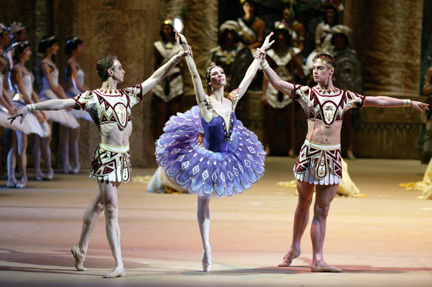
First: Maria Alexandrova and two unidentified cavaliers.
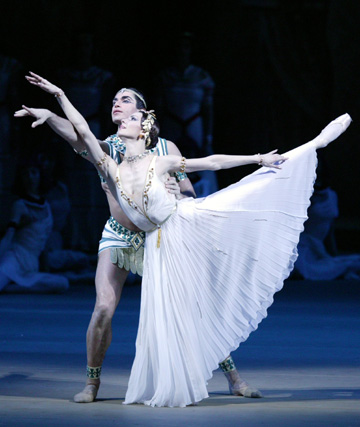
Second: Maria Alexandrova and Nikolai Tsiskaridze
Corrections:
In my review "Ratmansky's Dazzling 'Bright Stream,'" posted on 25 July 2005, there was an error in the name of the editor of the English anthology of Lopukhov's writings: the editor is Stephanie Jordan, not Lynn Garafola.
On 2 August 2005, Robert Greskovic of The Wall Street Journal wrote to advise me of two errors in my review "Retrofitting the Mummy," posted 1 August 2005. The character who removes the veil from the putative Aspicia is the Nubian king, not the Pharaoh. He also wrote: "Gorsky's production [of "The Pharaoh's Daughter"] was done for Moscow, where it lived and [where] Pavlova first went to dance the lead, before breaking Kchessinska's "monopoly" in St. Petersburg." My thanks to Mr. Greskovic and my apologies to readers. --M.A.
Volume 3,
No. 30
August 1, 2005
copyright
©2005
Mindy Aloff
www.danceviewtimes.com
|
|