Time Capsules
"Episodes," "N.Y. Export: Opus Jazz," "Firebird"
New York City Ballet
State Theater
New York, NY
January 25, 2006
by Lisa Rinehart
copyright ©2006 by Lisa Rinehart
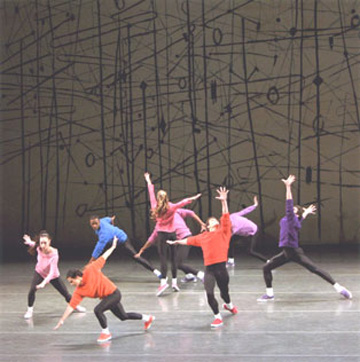 Dances can capture the tenor of a time, but only a few manage timelessness. Balanchine's 1959 work "Episodes," (trimmed of the Graham contributions), is as slick and tight as greased hair and black Capri pants, but nonetheless relevant to 2006 anxieties. Jerome Robbins' "N.Y. Export: Opus Jazz," on the other hand, is inextricable from the on-the-edge-of-exploding sensibilities of 1958, and what was hip and disaffected then is quaint by today's standards.
"N.Y. Export: Opus Jazz" was an outgrowth of Robbins' work for the stage musical, "West Side Story," and the title betrays the choreographer's desire to snare the early rumblings of the youth movement into a dance that could wow with its vitality. And it did. As long as audiences believed they were being let in to an exotic world of Latino and African-American rhythms (as interpreted by white youth), "Opus Jazz" was a window to a secret America struggling to posture tough in the face of change.
The dancers regard the audience dispassionately, unconcerned with pleasing, and Robbins catches the tenseness in short finger snaps, explosive stops and starts, smug shoulder shrugs and up-stretched arms with fingers spread wide as though challenging the heavens to pay attention. He moves the dancers from tough to playful as they bump and jive to Robert Prince's jazzy score.
At its inception, the dance's foreign and fresh vocabulary suggested a coming shift in the cultural winds. That shift, of course, was a bona fide hurricane of events that would, in a few short years, make Robbins' dance look like a glee club skit. Race riots, assassinations, an unpopular war, and feminism were symptoms of a country mutating violently from within, and the world Robbins had so carefully constructed ceased to exist.
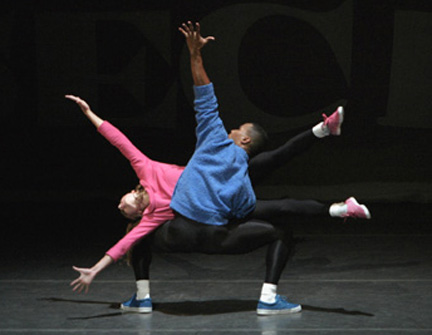 In its present revival, New York City Ballet dancers do a good job of not looking like ballet dancers. They fill the large stage of State Theater as best they can, (the dance was created for an intimate space), the music's jumpin' in the pit and the set is an abstract splash of black line and color, but it is impossible to duplicate the clenched jaw of repressed anger and fear that pervaded the late 1950's. The dancers don't have the pent-up fury in their bones to give the movement menace and what's left is a bunch of well-scrubbed kids cutting up on a decorative rooftop. This isn't the fault of the dancers, it's a collective understanding that there's no going back — even by way of an expert facsimile. The one exception is the "Passage for Two" danced by Rachel Rutherford and Craig Hall. Nobody does nonchalant hooking up between couples as well as Robbins and the pas de deux still resonates.
As a whole, however, Balanchine's "Episodes" has aged better, paring late fifties angst to its core and shimmering with contradiction and complexity fully pertinent to the present. The dance is an "ants in the sugar bowl" construction set to the orchestral works of Anton von Webern. Balanchine described Webern's 12-tone based music as "fill(ing) air like molecules," and he mists us with a perfume of spare angles, cocked heads and flexed feet as smoothly edgy as a Scandinavian coffee table. Even the final section, set to Webern's orchestration of the "Ricercata" from Bach's "Musical Offering," is elegantly taught and constrained to the point where we expect the entire construct to snap and fall slack. It never does and the dance ends with the eccentricities of the early sections encased in an icy veneer of normalcy.
The nakedness of this dance has got to be a psychological nightmare for the dancers, but "Episodes" benefits from strong personalities. Unfortunately, there were few to be found in the evening's performance. The group work was — never thought I'd say it — almost too precise and felt dry. Teresa Reichlen and Jason Fowler were a little clumsy in the pas de deux, although Reichlen's sexy femininity could blossom into something interesting over time. And Darci Kistler exuded refinement in the final section, but appeared fragile and overly careful. Balanchine built quirky lightness into this dance — the dancers shouldn't let the stark exposure scare them stiff.
The program concluded with Balanchine's "Firebird" which will be performed as long as new ballerinas emerge to dance it. Ashley Bouder, a powerhouse, is miscast as the vulnerable, orchid-like Firebird, but Chagall and Stravinsky deliver a feast for the senses that is pure theater at its florid best.
Photos, both by Paul Kolnik, are of the New York City Ballet in "NYExport, Opus: Jazz." The soloists are Rachel Rutherford and Craig Hall.
Volume 4, No. 4
January 30, 2006
copyright
©2006 Lisa Rinehart
www.danceviewtimes.com
|
|