Sounddance/Springdance
by Nancy Dalva
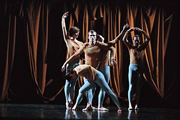 Every two years, in the spring, The Merce Cunningham Dance Company plays the Kennedy Center, a theater where the company, and especially the choreographer, are held in high and affectionate regard. Indeed, among Merce Cunningham's many honors are those bestowed by the Kennedy Center. This is then, his house. And it is, too, our house, because it sits on the Potomac, in the city which belongs to the nation. The Cunningham company plays the world, and has for more than fifty years, but to see them in Washington is always somehow significant, just as to see them in Paris is somehow always magical, and to see them in California is to be drenched, somehow, in sunshine. That is, each city, each theater, each night has its own character, its own correspondences. One cannot escape the political in Washington, and so, although this choreography and this artist are as removed from that scrum as, say, the planet Neptune, there are force fields. read more
 James Sewell tries hard to make amusing, irreverent and meaningful dance, but with the three pieces on offer at the Joyce, he comes up short. His influences are a mixed bag of classical ballet, six years of contemporary dance with Feld Ballets/NY, and dabblings in yoga and Qigong. The result is work that's decently structured, professionally presented and essentially unremarkable—a virgin pina colada for the subscription set.
 Britain had modern dance before 1967 when Robert Cohan, a New Yorker who had studied and performed with Martha Graham, was invited there to teach, build a company and choreograph. A little of that before-Cohan modern was indigenous (Florence Mills, Penelope Spencer, anyone else?), a little more had escaped from Central Europa (Laban, Jooss, Leeder, Nirenska, Holger, et al.). It subsisted, whereas Cohan's work took root. Phoenix grew from one of those roots, and to honor Cohan the company has revived his "Forest" of 1977.